What is Somatic Shadow Work?

You've probably heard the term "shadow work" floating around. Maybe you've seen it on Instagram, come across it in a book, or had someone recommend it after you mentioned you felt stuck. And maybe you've also thought, “okay, but what does that actually mean?”
That's a fair question. Because shadow work has become one of those phrases that gets used a lot without much explanation. And somatic shadow work even more so.
So let me break it down. Not in a textbook way. In a real, human way that actually makes sense.
First — what is the shadow?
The shadow isn't inherently your dark side. But it does contain the parts of you that were treated as broken, bad, or too much — by the people around you, by the environments you grew up in, by the messages you absorbed about who you were supposed to be.
And because they were treated that way, they learned to hide.
They didn't disappear. They just went underground. They learned to be quiet. To stay out of sight. To let the more acceptable version of you take the wheel.
That's the shadow. Not a monster. A protector.
Psychologist Carl Jung originally described the shadow as the parts of ourselves we disown.
But I'd take it further: the shadow is what we learned to abandon in order to belong.
What is shadow work?
Shadow work is the process of turning toward those parts instead of away from them.
It's not about digging up trauma for the sake of it. It's not about endlessly analysing your childhood. And it's definitely not about sitting in the darkness and calling it healing.
Real shadow work is about integration. Recognising the parts you've pushed away, understanding why they exist, and slowly bringing them back into the whole of who you are.
When you do that, something shifts. The patterns that kept repeating start to loosen. The reactions that confused you start to make sense. The exhaustion of performing a version of yourself that isn't quite real begins to lift.
What makes somatic shadow work different?
This is where it gets important.
Most personal development work happens in the head. You reflect, you understand, you get insight. And that insight can be genuinely valuable. But for a lot of people, it only goes so far.
You can know exactly why you people please. You can trace it back to your childhood, name the wound, understand the pattern with complete clarity. And then still do it anyway.
That's not a failure of awareness. That's the limit of awareness.
Because the body holds things the mind can explain but cannot resolve on its own. Patterns aren't just stored in your thoughts. They're stored in your nervous system. In the way you hold your breath when someone raises their voice. In the tension that lives in your shoulders by 3pm every day. In the freeze that moves through you when someone asks what you actually want.
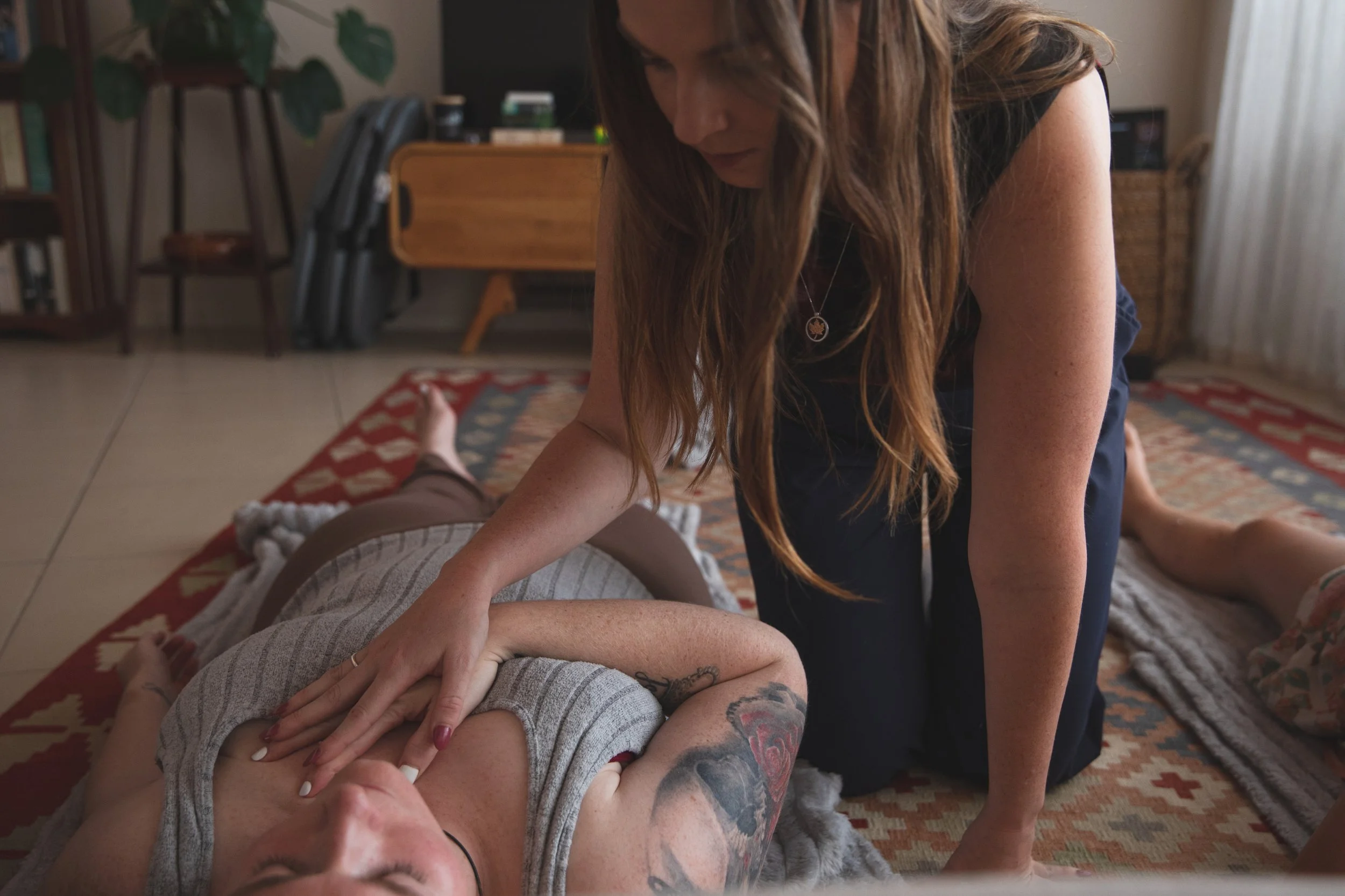
Somatic means body-based. Somatic shadow work brings the body into the process, working with the nervous system, not just the narrative.
Instead of just talking about the pattern, you feel it. You notice where it lives in you. You work at the level where it actually operates, not just the story you've built around it. You create safety in the body, not just in your understanding.
This is why somatic shadow work creates changes that stick. Because you're not just updating what you think. You're updating the system underneath.
What does somatic shadow work actually look like?
It can look different depending on the practitioner and the approach.
In my work, it often includes:
Slowing down enough to notice what happens in your body when a pattern activates.
Feeling the tightness, the contraction, the urge to disappear or overfunction or shut down.
Getting curious about that response instead of immediately trying to fix it.
Understanding what that part of you originally needed, and why it learned to protect itself the way it did.
And then, gradually, creating new experiences in the body through nervous system regulation, somatic practices, and the real relational work with those hidden parts.
It's slower than hacking your mindset. It's also far more lasting.
Who is somatic shadow work for?
Somatic shadow work tends to be most powerful for women who have done a lot of personal development work and still feel stuck. Who understand themselves well but can't seem to shift the pattern. Who are tired of feeling like they're performing their life rather than actually living it.
If that resonates, it's worth knowing: the missing piece usually isn't more information or more self-awareness. It's embodied change. Working at the level where the pattern actually lives.
A last thought that I feel I say a lot to people stepping into Shadow Work
Shadow work doesn't have to be dark, scary, or destabilising. When it's done with the right support, it's one of the most self-compassionate things you can do. Because the shadow isn't your enemy. It's the part of you that did its best to keep you safe. Somatic shadow work is the process of going back for those parts. And letting them know they don't have to hide anymore.
